
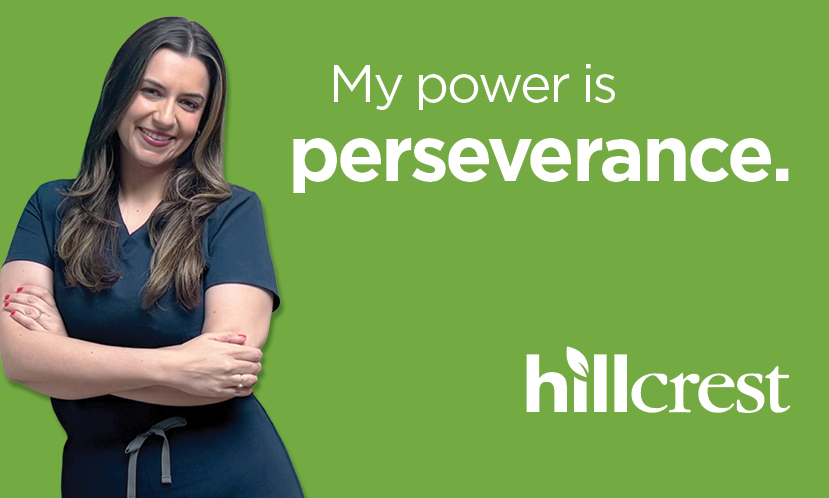
Working in the emergency room (ER) isn’t for the faint of heart. It’s an extremely high-stress job in which doctors and nurses can experience the highest of highs and the lowest of lows all in a matter of hours. ER staff must be ready for anything. But at Hillcrest facilities across Oklahoma, Courtney Pulliam, LPN, is one of the nurses putting compassion at the forefront of everything she does.
“I learned from a very early age that I was sensitive,” said Pulliam. “I loved everything and everyone and believed no one or thing should be hurt – yes, my stuffed animals included. Who was going to protect them all, if I didn’t?”
Pulliam knew she wanted to be a nurse from a young age. When she was 5 years old, her grandmother was diagnosed with Stage III renal cell carcinoma that had metastasized to the bone. Throughout her grandmother’s illness, Pulliam stayed close by her mom while she provided care every step of the way. But the disease took a turn for the worse and they watched as Pulliam’s grandmother slowly passed away on hospice.
“I admired my mom’s giving spirit,” said Pulliam. “She never wavered from her. The sacrifices she made to make sure Nana was comfortable and gave her the liberty to pass with her pride/dignity is something I strive for in my career as a nurse. My mom has always been a prime example of selflessness. My mom went on to get her CNA and patient care became her way of life. I followed in her footsteps and worked as a CNA for 12 years, while working towards my LPN/RN.”
Pulliam began her education at Connors State College in 2014, then transferred to OSU IT with the intention of being accepted into their RN program. She graduated in the fall of 2016 with her associates degree in allied health and disorders and was then accepted into the RN program in fall 2017.
“Unfortunately, I did not pass my first semester,” said Pulliam. “I let that weigh on me for years. I doubted nursing, my intelligence and let it affect me negatively, even though the health field is where I felt called. After taking an aide position at Grace Hospice in 2018, the calling got louder. I knew I had to keep going.”
Pulliam applied for LPN school again in 2023 and was accepted into Green Country Technology Center’s LPN program.
“I graduated in June of 2024 president of my class, presented a commercial over fentanyl in HOSA and won internationally, found my drive again, and honestly, I found me,” she said.
These days, Pulliam works at multiple Hillcrest facilities across Oklahoma. She works in the med-surg unit/ER at both Hillcrest Henryetta and Hillcrest Cushing, and also picks shifts up at Hillcrest Medical Center ER. But these facilities face challenges of their own.
“In rural healthcare settings, we navigate a unique and often overlooked reality,” said April Secor, chief nursing officer (CNO) at Hillcrest Henryetta. “Our hospitals serve as the backbone of our communities – frequently the only point of care for miles – yet we are too often overshadowed simply because we do not have the specialty services or intensive care units found in larger urban centers. The absence of these resources doesn’t reflect a lack of dedication or capability; it reflects the difficult truth of practicing healthcare in low‑volume, resource‑limited environments.”
Pulliam says there’s one thing that all of these rural healthcare facilities have in common: nurses committed to uplifting not just their patients, but one another.
“There are things I have become excellent at in my short period of time while being a nurse, but there are also things I still struggle with, or haven’t fully grasped an understanding of,” said Pulliam. “And not one time has someone dismissed me or discredited my abilities/skills as a nurse. We all show up tired, we all have weights we carry that our coworkers/patients do not see, and the keywords in this sentence is that ‘we all show up,’ not just for the patients – for each other.”
“Rural teams work with extraordinary resilience, managing complex conditions with fewer staff, limited technology and the constant pressure of transferring patients who might otherwise be cared for locally if the infrastructure existed,” Secor said. “It can be disheartening when the essential work done in these settings is underestimated. But the reality is this: caring for patients in a rural hospital requires resourcefulness, clinical strength and a deep commitment to community. Courtney is an extraordinary example of how our nurses and staff embody this in the rural setting.”
For her efforts, Pulliam has won a DAISY award and been nominated multiple other times.
“I was truly shocked,” Pulliam said about her award. “I am a newer nurse and had heard talk of the DAISY award when I started in 2024, but wasn’t sure what qualified me or if patients actually filled them out. I have seen several nurses wearing their daises proudly and love hearing their stories how they gained theirs over the years.”
Now, Pulliam joins the ranks of nurses who have made a lasting impact – not just on her patients, but on her community as a whole.
“I hope that when I am ever in need or experiencing an emergency, someone shows me the same kindness,” said Pulliam. “This world is already unkind; I never want to add to it. If I made the difference in one, I made a difference.”