Emergency care services in Northeast Oklahoma
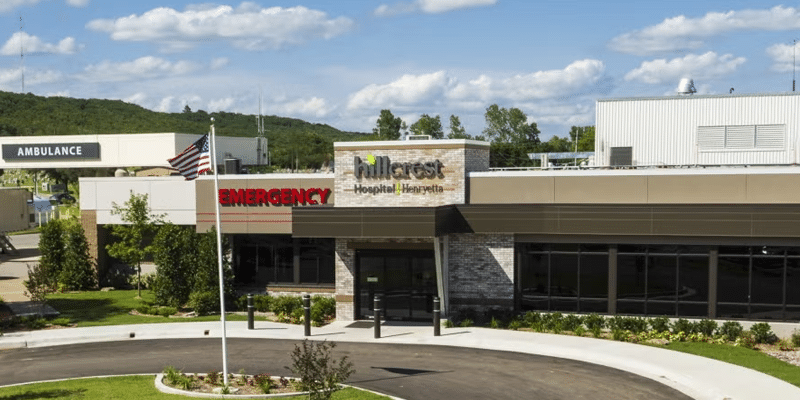
When every second counts, Hillcrest Hospital is here for you. Our 24-hour emergency rooms (ERs) provide lifesaving care for patients with critical illnesses, injuries, and sudden health emergencies. Staffed by nationally recognized ER doctors and nurses, our teams deliver fast, effective emergency medical services for patients across Northeast Oklahoma.

Comprehensive emergency conditions we treat
Our emergency rooms are equipped to handle a wide range of urgent and life-threatening conditions, including:
- Heart attack and chest pain
- Stroke and neurological emergencies
- Severe burns, cuts, and lacerations
- Fractures and broken bones
- Severe abdominal pain or infections
- Major head and bodily injuries
- Respiratory complications and severe breathing difficulties
If your condition is not life-threatening, our staff may connect you with the appropriate Hillcrest medical department or refer you to urgent care.
What to expect when you arrive at our ER
Upon arrival at our ER, you will be greeted by a member of our staff who will ask for basic information in order for you or your loved one to be quick-admitted, or admitted on a preliminary basis. You will need to sign a consent form for treatment, and for children under 18, consent of a parent or legal guardian is required.
You will then be triaged for treatment. Triage is the process by which individuals are screened based on the severity of their condition. Our emergency team implements the triage process to streamline your care while minimizing wait times.
Please be prepared to provide pertinent information about your medical history, including any medications you are taking, any allergies you may have, and a summary of your past illnesses, injuries and surgeries. Having this information readily available greatly assists our medical team in making informed decisions regarding your care.
Individual wait times can vary widely in the ER. Wait times are based on the number of beds available, the number of patients needing care and the severity of their conditions. In emergency rooms, patients are not seen on a “first-come, first-serve” basis. Instead, they are seen in the order of the severity of illness or injury. For example, heart attack patients and near-drowning victims are seen before patients with cuts or broken bones. Therefore, patients with the most serious and life-threatening conditions will be seen first.
If you are experiencing a medical emergency, please call 911 or visit the nearest emergency room.
Understanding ER wait times
We do our best to keep you updated on wait times. Please keep in mind that we are continuously receiving patients via ambulance through a separate entrance. Wait times may change based on the number of patients we receive. Proper medical care takes time. After you have been seen by a physician, it may take some time before a decision can be made about your status. Your physician may be waiting for one or more of the following:
- Results of lab tests
- X-ray interpretation
- Observation of any changes in your condition
- Reassessment of your condition
- Observation of the effects of any treatment, e.g., medications
- A bed assignment (if you are admitted)
If you have any questions, please speak to one of our staff members.
Recognizing a heart attack – when to call 911
Call 911 if you or someone else displays the following heart attack symptoms:
- Chest pain/discomfort
- Feeling lightheaded
- Nausea/vomiting
- Pain or discomfort in the jaw, neck, back, arm or shoulder
- Shortness of breath or difficulty breathing
- Unusual fatigue
Recognizing a stroke – BE FAST
There are many symptoms of a stroke that patients should be aware of. One way to remember the most common symptoms is to BE FAST:
- B – Balance. Is the person suddenly having trouble with balance or coordination?
- E – Eyes. Is the patient experiencing sudden vision troubles? This includes blurred vision, double vision, or loss of sight in one or both eyes.
- F – Face drooping. Ask the person to smile. Is one side of their face numb or drooping?
- A – Arm weakness. Ask the person to raise both arms to the same level. Does one arm drift downward? Is one arm weak or numb?
- S – Speech difficulty. Ask the person to say a sentence. Are they struggling to speak normally?
- T – Time to call 911. If the person is experiencing ANY of these symptoms, call 911 immediately.
Call 911 if you or someone else is displaying stroke symptoms. Patients who arrive at the ER within three hours of initial stroke symptoms have less chance of disability three months after a stroke than those who received delayed care.